Rentokil and Terminix are joining forces to serve you even better!

1-855-633-6260 Call us for a free quote Contact us

Common stored product pest species

The term “stored product pests” covers a large variety of insects, including beetles and moths. Learn more below about common species of stored product insects (SPIs) found in the U.S.

If you have a question about a specific stored product pest, call us today at 1-855-633-6260 to speak to one of our professionals.
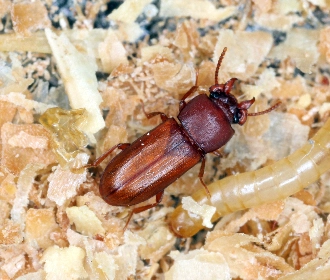
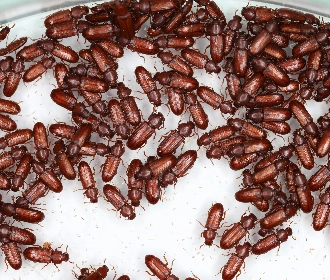
Broadhorned flour beetle

Broadhorned flour beetle

(Gnatocerus cornutus)

  • About 3.5 – 4.5 mm in length.
  • Red-brown in color.
  • Male have two enlarged mandibles on the head, giving the appearance of horns.
  • Females are very similar in appearance to the confused flour beetle.

  • Adult beetles can live for 1 year or longer.
  • Female lays 100 to 200 small white eggs that hatch in 4-6 days in warm weather.
  • Development period from egg to adult is 6-8 weeks.

  • Frequently found infesting flour and feed mills.
  • Feeds on flour, dough, semolina, cornmeal, beans, corn, yeast and sugar cane.
  • Moth eggs and larvae may supplement the broadhorned flour beetle diet.
Cigarette beetle

Cigarette beetle

(Lasioderma serricorne)

  • 2-4mm (1/16-⅛”) in length.
  • Adult is tan to dark brown.
  • Closely resembles the drugstore beetle.
  • Head bends down nearly at right angles to the body, giving it a humped back appearance when viewed from the side.
  • Does not have distinct pits arranged in rows like the Drugstore beetle.
  • Larvae are white with many long hairs.
  • Larvae are about 4 mm (⅛”) long and somewhat bent.

  • The adult beetles live from 2 to 4 weeks and during this time the females may deposit between 10-100 eggs.
  • The eggs are laid loosely on the infested material.
  • The larval period usually ranges from four to five months, but under very favorable conditions the development from egg to adult may occur in 6 to 8 weeks.
  • When the larvae are fully grown, pupation occurs and they remain in this resting stage for 12 to 18 days.

  • Feeds off tobacco, dry stored food products, spices, seeds, grains, and dried plant material.
  • Reported in rice, dried potatoes, paprika, raisins, grain-based mouse bait, and dried strawflowers.
  • Adult often wander away from infested materials and may be found throughout the area.
  • Can penetrate packages of food. Attracted to light and can fly
Confused flour beetle

Confused flour beetle

(Tribolium confusum)

  • Adults are 3-4 mm (about ⅛ “) in length, and the larvae are about 6 mm (⅛-¼”) long.
  • Adult is red-brown, and the larvae are a light honey color and about.
  • Resembles the Red flour beetle, except for the antennae, which are four segmented and gradually thickens towards the tip - another slight difference is in the thorax shape.
  • Sides are curved, whereas the thorax of the confused flour beetle is straighter. It has well-developed wings but seldom flies.

  • Adults can live over 3 years, and females may lay eggs for more than a year.
  • Eggs are deposited directly in flour or other food material or attached to the surface of the container. They are white or colorless and covered by a sticky material to which flour can adhere.
  • Eggs hatch in 3 - 5 days at 90-95°F. Larvae burrow into grain kernels but may leave their burrows searching for a more favorable food.

  • Feeds off grain, flour, and other cereal products, beans, cacao, cottonseed, shelled nuts, dried fruit, dried vegetables, drugs, spices, chocolate, dried milk, and animal hides.
  • Unable to feed on whole grain but can feed on broken kernels usually present.
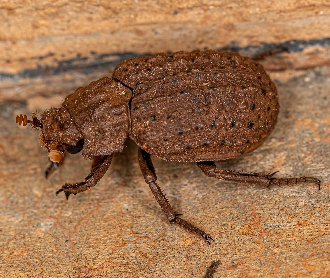
Drugstore beetle

Drugstore beetle

(Stegobium paniceum)

  • Adults are about 2-3.5 mm (1/16 -⅛”) long.
  • Red-brown in color and oval-shaped.
  • The larvae are small and white, approximately 2-3 mm (1/16 - ⅛”)  long.
  • Have longitudinal rows of pits on elytra and three-segmented clubbed antennae

  • Adults live from 2 to 4 weeks.
  • Hatching larvae are 0.5 mm long and very mobile.
  • Larval period usually ranges from four to five months, but under favorable conditions, the development from egg to adult may occur in 6 to 8 weeks.
  • When the larvae are fully grown, pupation occurs, and they remain in this resting stage for 12 to 18 days.

  • It is not a major pest in stored grains but will attack spices, seeds, grains, dried plant material, and packaging materials such as paper and cardboard.
  • They are known to feed on leather, wool, hair, and books.
  • Their presence can be detected from pinhead holes in the infested items.
  • Packaging materials such as paper and cardboard are also attacked.
  • Since the drugstore beetle can fly well, the source of infestation can sometimes be hard to find.
Granary weevil

Granary weevil

(Sitophilus granarius)

  • Adults are about 2.5 - 5 mm (⅛ - ¼”) in length.
  • Dark brown-black in color.
  • Possess a long slender snout and cannot fly.
  • Larvae are legless, humpbacked, white to creamy white, with a small, tan.
  • In the pupa stage, possess snouts like adults.

  • Egg, larva, and pupa stages occur in the grain kernels and are rarely seen.
  • Emergence holes of the granary weevil are fairly large and tend to be more ragged than smooth and round.
  • Females drill a tiny hole in the grain kernel, deposit an egg in the cavity, then plug the hole with a gelatinous secretion.

  • Granary
  • Most of their life is spent within the grain kernel.
  • Both larvae and adults feed on grain.
  • Can attack hard cereal products, e.g., macaroni and spaghetti.
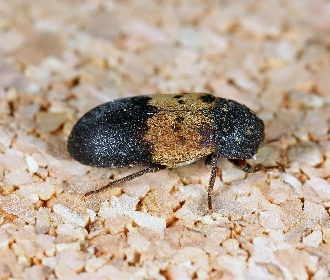
Hide beetle

Hide beetle

(Dermestes maculatus)

  • Adults are 1/4"–3/8" in length.
  • Uppermost is black, underside is white.
  • Larvae are about 15-17 mm (about ⅝ - ¾”) in length.
  • Larvae are worm-like, hairy, and reddish to dark brown with an orange stripe running down the length of the back
  • A pair of spines on their tail end curves upward away from the abdomen (urogomphi).

  • Life cycle from egg to adult, on average, takes 60-70 days, depending on humidity, temperature, and the food.
  • Adults live for about 60-90 days.

  • Preferred food materials are skins and hides, but will feed on smoked meat, hams, dried fish, and dried cheese.
  • Larvae may bore into soft wooden materials to pupate.
  • Larvae shun the light, but adults do not and are strong fliers.
  • Can be found in both residential and commercial structures depending on the location of food sources listed above.
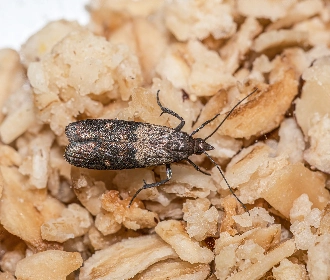
Indian meal moth

Indian meal moth

(Plodia interpunctella)

  • Adult

  • Adults are about 12.7 mm (about ½”) long with a wingspan of about 16 to 20 mm (⅝ - ¾”).
  • Forewings are bicolored with the base (part closest to body) cream to yellow and the outer portion coppery red to dark grey.
  • At rest, wings are held roof-like over the body.
  • Head and thorax of the moth appear gray and the posterior brown, with a coppery sheen.
  • Larvae

  • Color is usually off-white but has been observed to be pink, brown, or almost greenish, depending on the food source.
  • Mature larvae are about 9-19 mm (½ - ¾”) long.
  • They have five pairs of well-developed prolegs that help them move considerable distances to pupate.
  • There are five to seven larval instars.
  • Pupae

  • Larvae pupate either in a silken cocoon or unprotected.
  • Pupae are 6 to 11 mm (about ¼-½”) and are pale brown in color.

  • Eggs hatch within seven to eight days depending on the temperature
  • Larvae can complete their development within five to eight weeks, depending on temperature. 
  • Depending on the temperature, pupal stage may take seven to 20 days.

  • Feed on dried fruits, grains, seeds, nuts, chocolate, candies, birdseed, dog food, powdered milk, dried red peppers, and candy.
  • Attracted to the light, these bugs are found worldwide in areas where food is stored, such as grocery stores.
  • Larvae produce large amounts of silk which can contaminate dried food goods.
Larder beetle

Larder beetle

(Dermestes lardarius)

  • Adults are about 8-10 mm (½”) in length.
  • Cream to yellow colored band across the top of their wing covers with six dark-colored spots inside it.
  • Larvae are 15-17 mm (about ⅜-¾”) in length.
  • Larvae are worm-like, hairy, and reddish to dark brown.
  • Larvae have a pair of spines(urogomphi) curve towards the abdomen on their tail end.

  • Eggs can hatch within two weeks
  • Depending on the temperature, the development from egg to adult can usually take 40-50 days but can take longer.

  • Feeds on various animal products, including dried fish, ham, bacon, meats, cheese, and pet food.
Psocids

Psocids

Some are called Booklice.

(Liposcelis spp.)
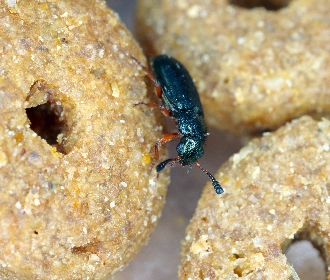
  • Adults vary in size according to species. 1-4 mm (1/32"-1/16") long. Pale yellow-brown to dark brown with long, slender antennae.
  • Generally white, gray, or brown in color.
  • Soft-bodies with four wings or are wingless.
  • Have a large nose called a clypeus.
  • Nymphs are very small, often appear transparent—no larval stages.

  • Depending on the temperature, development from egg to adult takes 18 days to 42 days.

  • Liposcelis bostrychophila — common in homes.
  • Lepinotus patruelis — common in factories and on pallets.
  • Attack grain in storage, handling, and processing facilities.
  • Flour and similar products are their most common food sources.
Copra beetle

Red-legged ham beetle/Copra beetle

(Necrobia rufipes)

  • Adults are 3.5-7 mm (⅛-¼”) in length.
  • Upper surfaces of the body are shiny metallic bluish-green. Underside of the abdomen is dark blue with bright reddish-brown or orange legs.
  • Antennae are reddish-brown with a dark brown or black club at the tip.

  • Eggs take between four and six days to hatch.
  • Larvae grow for 30 to 140 days, become less active, and look for a dark place to pupate.
  • Pupal stage takes the form of a silken cocoon and varies between 6 and 21 days.
  • Adult mates soon after emerging from its pupal stage and can live for up to 14 months.

  • Adults fly and can then  easily disperse to new sources of food.
  • Destructive in both the larval and adult stages, although the larval stage is the most destructive.
  • Cannibalistic, preying on their own eggs and pupae.
Red flour beetle

Red flour beetle

(Tribolium castaneum)

  • Red-brown in color.
  • Adults are 3.0 - 4.0 mm (about ⅛”) in length.
  • Antenna is distinctly club-like, with a three-segmented club and has grooved wing covers.
  • Well-developed wings and has been observed to fly.
  • Larvae are a light honey color and about 6 mm long.
  • Larvae’s head and a distinctive forked process at the tip of the abdomen are slightly darkened.

  • Adults can live over 3 years, and females may lay eggs for more than a year.
  • Eggs are deposited directly in flour or other food material or attached to the surface of the container. They are white or colorless and covered by a sticky material to which flour can adhere.
  • Larvae burrow into grain kernels but may leave their burrows searching for a more favorable food.
  • Larvae are fairly active but generally hide within the food, away from light.

  • When agitated or crowded, they may secrete chemicals called quinones. These chemicals can cause the infested feed to turn pink and have a pungent odor.
  • Have been reported in grain, flour, other cereal products, beans, cacao, cottonseed, shelled nuts, dried fruit, dried vegetables, drugs, spices, chocolate, dried milk, and animal hides.
  • Unable to feed on whole grain but can feed on broken kernels usually present.
  • Fungi may play a significant role in the nutrition of red flour beetles.
Rice weevil

Rice weevil

(Sitophilus oryzae)

  • Adults are 2.5 - 3.5 mm (about ⅛”) long.
  • Brown-black in color and possess a long slender snout.
  • Slender, hard-shelled body that appears pitted or scarred with tiny holes.
  • 4 faint red-brown spots on the back of the abdomen.

  • Adults live 3 to 6 months, infesting grain in the field.
  • Egg, larva, and pupa stages occur in the grain kernels and are rarely seen.
  • Females drill a tiny hole in the grain kernel, deposit an egg in the cavity, then plug the hole with a gelatinous secretion.
  • Egg hatches into a young larva that bores toward the kernel's center, feeds, grows, and pupates there.
  • New adults bore emergence holes from the inside, then leave to mate and begin a new generation.

  • Adults can fake death by drawing their legs close to the body, falling, and remaining silent when disturbed.
  • Emergence holes of the rice weevil are smaller than those of the granary weevil and tend to be smooth and round.
  • Generally no external evidence that the larvae have been eating and growing inside the seed until about one month when the adult weevil chews through the seed coat and emerges.
Saw-toothed grain beetle

Saw-toothed grain beetle

(Oryzaephilus surinamensis)

  • Adults are about 3 mm (⅛”) in length with a flattened dark brown colored body.
  • Adults have six sawlike teeth on each side of the prothorax, similar to the merchant grain beetle.
  • Temple area (region behind the eyes) is greater than half the vertical diameter of the eye.
  • Mature larva is yellowish-white.

  • Life cycle may take about 30-50 days, depending on the environment.
  • Adults usually live around 6 to 10 months.

  • Flat body shape allows it to crawl into damaged/unsealed packaging to eat, live and reproduce.
  • Larvae develop in flour, cereal products, and many other dried foods, including grains, cereals, bread, pasta products, dried meat, dried fruit and nuts, sugar, chocolate, candy, tobacco products, and drugs.
  • Common pest in grain bins and mills, processing plants, warehouses, and kitchens.
  • Feeds on broken kernels and grain residues in grain storage bins.
  • Cannot fly.
Warehouse beetle

Warehouse beetle

(Trogoderma variabile)

  • Adults are oval and about 3.2 mm (about ⅛”) in length.
  • Mostly dark brown, with mottled lighter brown markings.
  • Larvae are about 6.5 mm (¼”) long and vary in color from yellow-white to dark brown, depending on age. The last three to four segments of larvae have very long tufts of hair.
  • Larva has 3 pairs of legs and is very bristly.

  • Life cycle of about 2-4 months depending on the environment and food supply.
  • Larvae can slow their development by molting numerous times before they decide to pupate.

  • May be found in many organic materials such as seeds, grains, most types of packaged foods, snail baits, dog biscuits, stock feeds, old rodent baits, grain remnants in sacks, bee and wasp nests, rodent carcasses, dead insects, animal droppings, etc.
  • Long hairs dropped by larvae may cause human problems such as asthma, skin problems, or gastric disorders in infants, children, and at-risk individuals.

Get rid of stored product pests

Find out how Rentokil can help

Get in touch

Contact an expert

Signs of Stored Product Pests

Know what to look for