Rentokil and Terminix are joining forces to serve you even better!

1-855-633-6260 Call us for a free quote Contact us

Types of snakes & identification

Most snakes prefer to stay away from people, and only a few U.S. species are venomous. Here are some of the more common snakes you might find on your property:

Common garter snake

Common garter snake

(Thamnophis sirtalis)

  • Size: Roughly 46-137 cm long.
  • Color: Varied - can be olive, black, grey or brown, often with 3 light-colored stripes on back
  • Head: wider than neck
  • Body: Females are typically larger than males, but males typically have longer tails

  • Garter snakes will begin to reproduce as soon as they emerge from hibernation.
  • Most female snakes give birth between August and October.
  • The gestation period is roughly 2-3 months.
  • In the wild, the average garter snakes live for 2 years.

  • Diet: Small rodents, amphibians, snakes, insects and spiders
  • Habitat: Deciduous forests, forest edges, fields, swamps, streams, rivers, pond edges, overgrown lawns and grassy areas
  • Visibility: Primarily active during daylight and can survive in many different temperatures
Copperhead snake

Copperhead snake

(Agkistrodon contortrix)

  • Size: 24-36 inches long
  • Color: Chestnut with dark brown/greenish bands.
  • Head: Copper-colored
  • Body: Thick and heavy

  • Breed from spring to fall, but not every year
  • Give birth from late summer to early fall
  • Typically produce 4-7 snakes, but can be anything from 1 to 20
  • Hibernates from mid fall to early spring

  • Diet: Small rodents, birds, lizards, snakes, amphibians, and insects.
  • Habitat: Rocky areas with thick underbrush, vines, vegetation and/or debris, even in heavily populated regions. They often go unnoticed when lying on dead leaves or red clay. In suburban areas, Copperheads hide in stone walls, compost piles, and under decaying stumps, abandoned building debris and flat stones.
  • Visibility: Can be seen during the day, but in the heat of summer, they’ll stay hidden during the day and only come out at night.
Cottonmouths or Water Moccasins

Cottonmouths or Water Moccasins

(Agkistrodon piscivorus)

  • Size: Roughly 2 ft. 8" long
  • Color: The back is dark olive or black, and the belly is paler
  • Head: Triangular head with slit-shaped pupils, fangs, and a white lining in its mouth, hence the name “Cottonmouth”
  • Body: Has crossbands with a distinct border extending all the way around and across the stomach

  • Breed in spring and fall
  • The gestation period can be 3-4 months
  • Produce a litter of up to 12 young
  • Hibernate during winter along hillsides and above streams

  • Diet: Fish, frogs, lizards, birds, small mammals, and other snakes
  • Habitat: Semi-aquatic, spending most of their time close to permanent water sources
  • Visibility: Primarily active at night, but they bask in the sun during the day, often on branches overhanging the water.
Eastern diamondback rattlesnake

Eastern diamondback rattlesnake

(Crotalus adamanteus)

  • Size: Average is 91-183 cm, but it has been reported as large as 244cm, the largest rattlesnake and the heaviest venomous snake in the Americas
  • Color: Brown/yellow color with dark brown/black diamonds outlined by yellowish scales
  • Head: has a dark stripe that runs diagonally through the eye
  • Tail: brownish or grey color and ends in a rattle

  • They mate in late summer and fall.
  • Females usually give birth to an average of 12 young in their shelters.
  • Young are born approximately 30-36 cm long with markings similar to adults except they have a button at the end of the tail in place of the rattle.
  • The young only stay with the mother for a couple of days before they go off to hunt for themselves and find their own shelter, so their mortality rate is fairly high.
  • They can live for over 20 years.

  • Diet: They feed on small mammals including mice, birds and rabbits.
  • Habitat: They favor dry pine forests, sand pine scrub areas and coastal barrier islands as well as wet prairies during dry periods and often inhabit gopher tortoise burrows as their shelters. They are strong swimmers and have been seen crossing water between islands and the mainland.
  • Visibility: Rattlesnakes usually hide during the day and emerge in the evening or at twilight to hunt for prey.
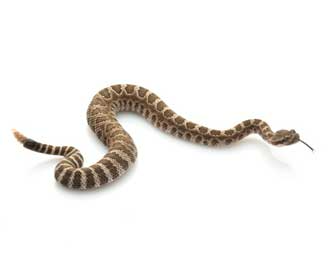
Rattlesnakes

Rattlesnakes

Crotalus and Sistrurus (More than 50 different species)

  • Size: Can be as long as 8 feet
  • Color: Different species of rattlesnake vary significantly in size and markings.
  • Body: Two enlarged venom fangs fixed to the front of the mouth with solid teeth in both jaws
  • Tail: Common feature is the ‘rattle’ on the end of their tails

  • Rattlesnakes give live birth rather than lay eggs.
  • Young rattlesnakes are independent and self-sufficient from birth.
  • Most rattlesnakes mate in the spring.
  • Newborn rattlesnakes do not have working rattles.  It is only after their first skin shedding that their rattles function.
  • Rattlesnakes shed their skin several times a year and each time they shed a new segment is added to their ‘rattle.’

  • Diet: Consists largely of small animals such as rabbits, rats, mice, etc.
  • Hunting: They kill their prey by injecting them with venom rather than constricting them and can strike without pulling themselves into the ‘S’ shape that most snakes do. They also attack as far as two-thirds of their length away from them. Generally, they only attack humans if cornered or provoked.
  • Habitat: Typically live in dry savannah and will generally move away from humans they encounter – but not always! Generally, they only attack if cornered or provoked. They are often found in and under boulders and logs as well as sunning themselves in the middle of trails.

Choose your industry

Get in touch

Contact an expert

Vegetation management

Rentokil Vegetation Management Service (VMS) will eliminate weeds or unwanted plants around your facility, highway, or railway.