(65) 6347 8138 Call us for a free quote Contact us

Common ant species

Many home owners are concerned when an ant colony in the house gets out of control. Frustrations come in when you find ants in your food almost too quickly the moment after you placed the food down on a table!

For residential, you can now quickly identify the ant species crawling in your home with this easy-to-read Top 4 Ant Species in Singapore Homes.

To know more in-depth about ants’ life cycle and their detailed habits, read more below for the 6 different types of ants which can be commonly found in Singapore.

Ants FAQ

To get rid of ants in your house, you can buy over-the-counter ant repellents in gel, spray, or chalk form. These solutions often contain some active ingredients in them that help eliminate ants to some extent. However, these formulas are not to be used for widespread ant infestations or a long term solution basis. If you suspect that you have an ant infestation, give your local pest control services a call.

Ants have workers who forage out for food and supplies outside of the nest, they also have carpenters that builds the 'tunnel' system from within the nest, and the queens are the ones who develops new carpenters and workers to keep the colony alive. Regardless of characteristics, ants are very attracted to abundant food and moisture so make sure that any food and drinks are stored away in air tight containers or are in the fridge. Your trash should be disposed of properly, leaving no crumbs on spills that may attract ants into your home.

To get rid of ants permanently, it requires both your housekeeping and proofing efforts together with the help of a local pest control service to give an initial assessment as to what type of treatment and solution to use for your ant problem.

The most common types of ants that will start a colony in your home are sugar ants, pharaoh's ants, crazy ants and carpenter ants. They are commonly found in homes where there is supply of water, sweet and sugar items and wooden furniture such as kitchen, bathroom, living room and dining hall.

A simple solution of 50% white vinegar and 50% water applied on your walls and surfaces can derail ants by musking the pheromone track that ants often leave to lead others to the food source or to their shelter. To get rid of ants permanently, you should engage regular pest control service from your local pest solution provider while maintaining your home sanitation standard and minimising ants' entry into your home.

Ants are attracted to food with even the faintest of smells, but sweets and sugar attract these pests the most. That means smells from sugary foods, such as chocolate, peanut butter, doughnuts, and many more, are highly attractive to ants.

Singapore is home to an astonishing diversity of ants. Recent research has documented 409 ant species (including subspecies) across 100 different genera. Of these, 121 species are newly recorded in the region, and 34 are endemic to Singapore (found nowhere else in the world).
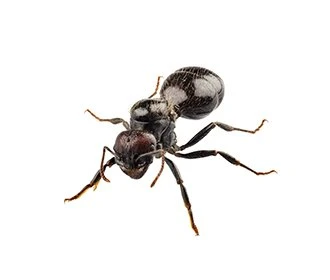
Black House Ant

Black house ant

(Ochetellus)

  • Shiny and black.
  • 2.5 - 3mm long.

  • Larva hatches out of the egg as a white grub which is narrower towards the head. They are fed by the adults.
  • The larva pupates and appears creamy-white, looking similar to an adult. Sometimes they have a protective silk cocoon around them.
  • The adult emerges with the three defined body sections: head, thorax and abdomen.
  • The length of time between the egg stage and ants emerging as adults can take 6 weeks or more; it depends on a variety of factors such as the species of ant, the temperature and the availability of food.
  • Fertilised eggs become female, unfertilised become males.

  • These ants are regarded as a nuisance and scavenge in kitchens, garbage and also dog excrement, therefore potentially spreading diseases such as salmonella.
  • The most effective control measure is to find the colony and treat it.
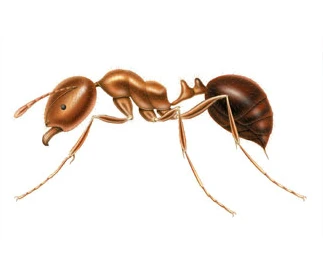
Fire Ant

Fire ant

(Solenopsis spp)

  • Queens 5/8" long. 
  • Workers 1/8"-1/4" long. 
  • Coppery–brown on the head and body, with a darker abdomen. 
  • Solenopsis has a very distinctive two–segment antennal club, which is most visible in the front view of the female reproductive ant.

  • After swarming from the nest and mating, the queen searches for a suitable spot to lay her eggs. Once found, she can lay up to 125 eggs in late Spring. 
  • Larvae hatch within 8 to 10 days, and the pupal stage lasts for 9 to 16 days. 
  • Larvae feed on secretions from the queen’s salivary glands and broken down wing muscles until the first worker ants emerge. After this first batch of larvae molt into workers the queen’s role returns to egg laying – she can lay up to 1500 per day. Worker ants continue with larval care, nest building and food foraging. 
  • Fertile males are produced later in the season.

  • Foraging workers diet consists of dead animals, including insects, earthworms, and vertebrates. Workers also collect honeydew and forage for sweet food, proteins, and fats. 
  • Nest locations can be a mound of up to 40 cm or next to objects found on the ground, e.g. logs. 
  • If aggravated, these react aggressively and can inflict a painful sting, resulting in a pustule some 48 hours later. 
  • These ants are a major agricultural and urban pest, destroying crops and invading residential areas both outdoors and indoors.
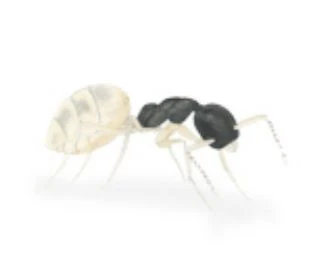
Ghost Ant

Ghost ant

(Tapinoma melanocephalum)

  • Pale/Translucent legs and abdomen.
  • 16mm long.

  • Continuous breeding colonies.

  • Feeding – indoors: sweet substances and grease; outdoors: insects that produce honeydew.
  • Nesting – indoors: small spaces, wall voids; outdoors: in flowerpots, under objects on the ground, under loose bark.
  • Locations - attracted to high moisture areas, can be found in kitchen and bathroom cabinets.
  • Colonies can occupy several different nesting sites.
Odorous house ant

Odorous house ant

(Tapinoma sessile)

  • Brown or black. 
  • 1/16 to 1/8 inch long. 
  • Antennae have 12 segments and are not terminated with a club. 
  • 6 legs.

  • Time to adult phase of development is 34-38 days. 
  • Typically live for several years.

  • Feeding - eat most household foods, especially sugary food, eg sweets and fruits such as melon. Also eat pet food. 
  • Locations – attracted to moisture. In hot, dry environments nests can be found in house plants and even lids of toilets. 
  • Odour - produce a coconut smell when crushed. 
  • Colonies - range in size from 100-10,000.
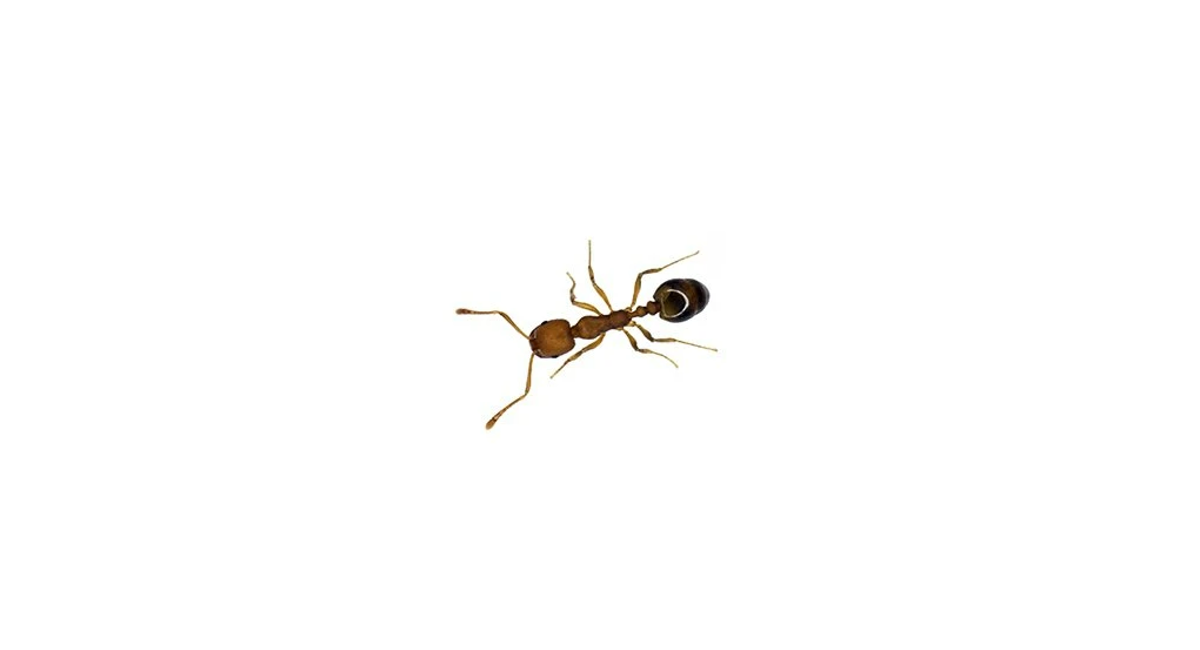
Pharaoh’s Ant

Pharaoh ant

(Monomorium pharaonis)

  • Workers 1.5-2mm long, yellow-brown with brown abdomen.
  • Males 3mm long, black, winged.
  • Queens 3.5-6mm long, dark red in colour with wings.
  • Black eyes, 2 small segments at the pedicel.

  • Multi-queen colonies.
  • Swarming can take place at any time of the year.
  • Winged adults seldom fly so rarely seen. Wings are soon lost after mating.

  • Well–defined trails are laid which are often associated with heating systems. Feeds indoors on high protein foods — meat, fats, blood, dead insects, etc.
  • Swarming characteristics — new colonies are often formed through nests that have been disturbed e.g., as a result of insecticide spray treatments.
  • Each queen produces up to 3,500 eggs in its lifetime.
  • Nest locations — deep seated in cavities in heated buildings. Often found in hospitals. Associated with humid conditions. Colonies can range from a few dozen to 300,000 individuals.
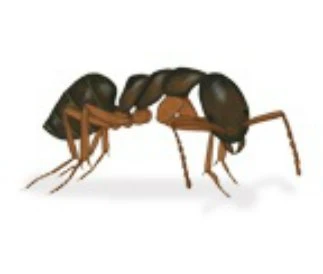
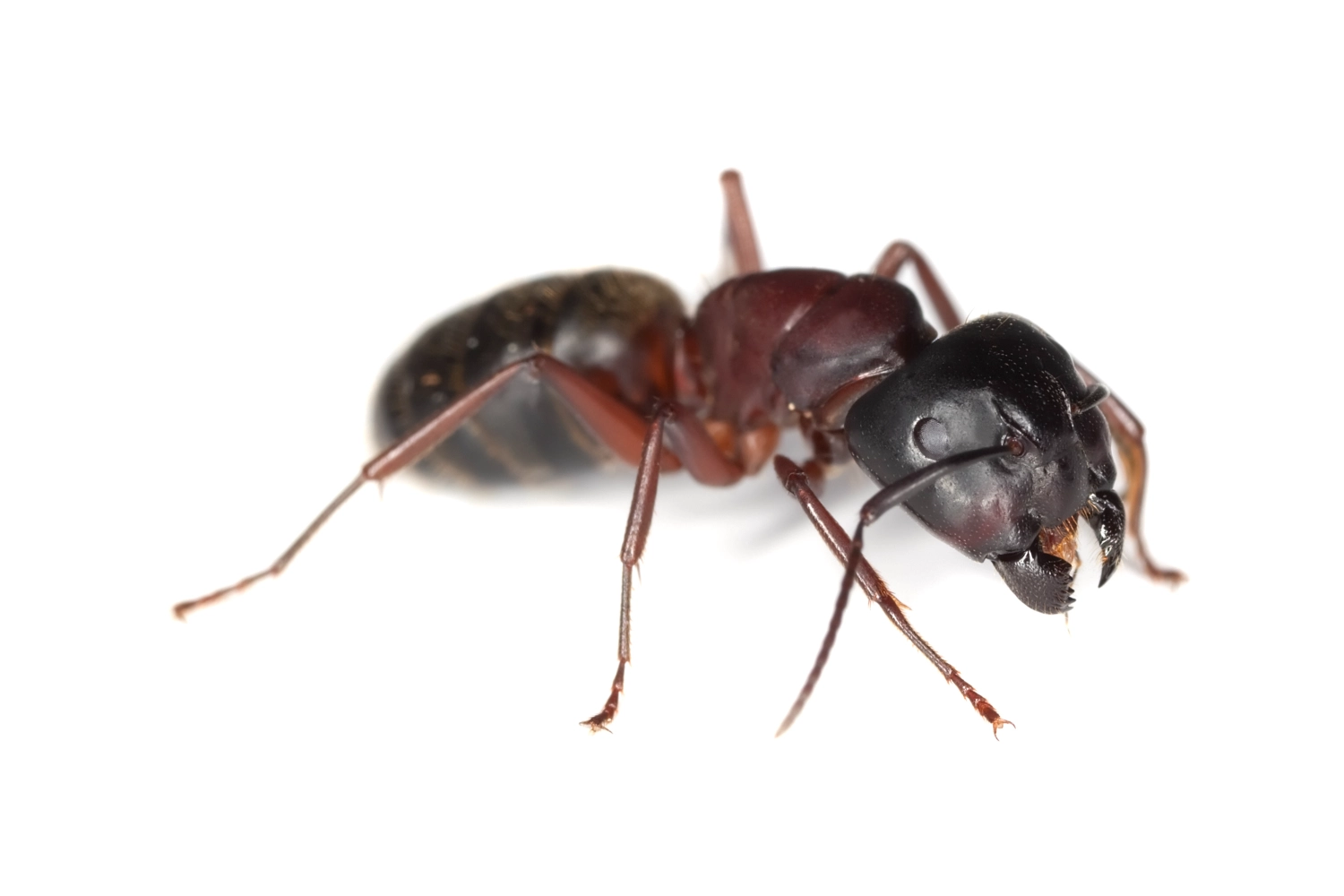
Carpenter Ant

Carpenter ant

(Camponotus pennsylvanicus)

  • Workers: 1/4" long.
  • Queen: 1/2" long.
  • Blackish color most common but can also be black and red.
  • 6 legs.

  • It takes 3 - 6years to establish a large and stable colony.
  • The life cycle of a carpenter ant is estimated to be 6 - 12 weeks from egg to adult.

  • Locations - both moist and dry wood, but prefer moist, e.g. wood dampened by water leaks.
  • Internally - excavate galleries in wood with a smooth appearance.
  • Externally - sometimes hollow out sections of trees.
  • Visibility - hunt for food mainly at night but also during the day in early spring / summer. Signs include sawdust, wet wood, or unusual noises coming from the walls.
  • Feeding - primary food is honeydew, also eat plant secretions, fruit juices and insect remains. They do not eat wood. In homes they are attracted to sweet substances, fats, grease and meats.
  • Contact - rarely come into contact with people, but if they do will try to escape. They cannot sting.

Why Ants Thrive in Singapore

Discover why ants flourish so well in Singapore’s environment.

Climate

Tropical temperatures year-round provide ants with a stable, warm and humid environment, ideal for rapid development, foraging, and nesting activities.

High humidity levels also support moisture-dependent species, enabling them to remain active and reproduce throughout the year with minimal interruption.

Resources

Readily available food: Ants can find food from many sources, including crumbs, sugary spills, leaking taps, outdoor plants, and nectar. They will make use of even the smallest amount of food they come across.

Outdoor vegetation: Gardens and landscaped areas provide sap, honeydew from insects, fallen fruit, and plant nectar. These sources can support ant colonies both inside and outside buildings.

Plenty of nesting sites: Cracks in walls, gaps under floors, spaces in pavements, plant pots, and utility pipes all offer safe places for ants to nest close to food and water.

Introduction of invasive species: Trade and human activity have brought in ant species from other regions. Many of these are highly adaptable and reproduce quickly, which increases the number and types of ants found in Singapore.

How to Prevent and Control Ant Infestations

Practical steps can significantly reduce the likelihood of ants entering your property and help keep them under control.

Eliminate Entry Points

  • Seal cracks and gaps around doors, windows, pipework and the building’s foundations with durable sealants to block common access routes.
  • Close even the smallest openings. Ants can squeeze through extremely narrow spaces, so a thorough inspection and sealing is essential.
  • Maintain the building perimeter by cutting back trees, shrubs and plants that touch walls or roofs, as these can act as bridges for ants.

Maintain Cleanliness

  • Clean surfaces regularly to remove crumbs, spillages and residues that may attract ants.
  • Store food in sealed containers and avoid leaving pet food out for extended periods.
  • Repair leaks and remove standing water in sinks, plant pots or other damp areas that can attract ants seeking moisture.

Get Rid of Ants

Find out how Rentokil can help

Get in touch

See the upcoming events that we will be holding and attending