myRentokil
myRentokil login© 2026 Rentokil Initial plc and subject to the conditions in the Legal statement
If we talk about cockroaches, ants, mosquitoes or even rats, these are common household pests that we are either familiar with or encounter often. However, stored product insect (SPI) is another pest that is commonly associated with food and causes damaging consequences when an infestation arises. In this article, Rentokil shares more about the stored product insect, the signs to look out for and ways to get rid of them effectively.
Stored product insects (SPI) are tiny pests that cause damaging consequences and financial implications to homes and businesses. They infest and damage ready to eat and use food or during the production process. They can infest at various stages from raw material production, packaging, distribution, home or store usage and individual consumption. Typically categorised as plant or animal-based association, there are many types of SPI species and here are the three groups of SPI:
These form the largest order in the animal kingdom, Coleoptera with over 400,000 species. They feed on and breed in a range of dried plant and animal products that humans use. Most of them can fly when they are adults to seek new food supplies and breeding sites.
Adult moths have no biting mouthparts as they suck liquid food. The larvae have biting mouthparts for eating solid foods and can chew through some types of packaging. The winged adults, obviously, are the most mobile and can fly to the food sources suitable for laying their eggs.
Mites are not insects, but arachnids and are related to spiders and ticks. They are the smallest of the pests at less than 1mm across when adult. They not only contaminate and taint food but also can cause allergic reactions. In addition, they can infest a wide range of foods causing food contamination.
Due to their attraction to food ingredients, stored product insects are a common pest in environments including food manufacturing, grocery stores, warehouses, storage rooms and kitchens. In particular, their presence is around food packaging, raw materials, sacks, inventories and food machinery. Some species such as the weevils may also be found outdoors such as garden, trees and plants and enter into your premise through cracks, gaps and crevices. Lastly, they favour dark, damp and moist conditions. Hence, it is important to keep the place well ventilated and free for water and moisture.
While we know pests are mostly attracted to typical comfort food such as grease, sugar, protein and juices, stored products insects favour the following:
There are certain conditions that place your home or premise high risk of an infestation. A place for shelter, seek food supplies, water, and a quiet site for harbourage and breeding is a high-risk environment. Some of the conditions that contribute to high infestation risks include:
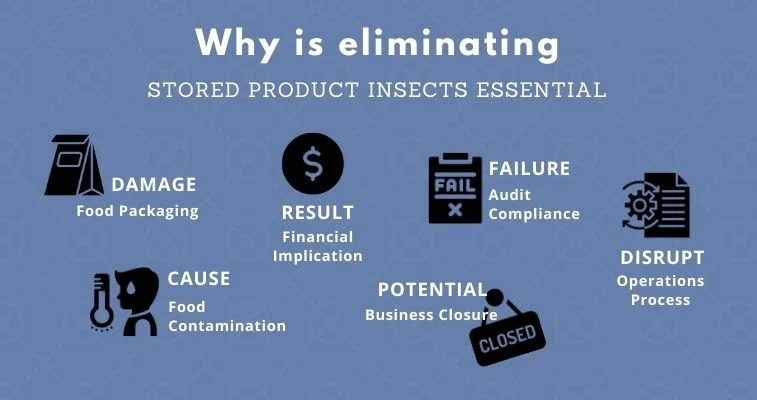
These pests similar to others are harmful to our health and safety and tend to cause monetary and time loss. Eliminating stored product insects especially in food sensitive and high dependency business is all the more important.
Firstly, they seek food supply and infest during raw production or food packaging that results in product recall or potential food contamination. Secondly, any presence of pests including the SPI would fail the necessary audit and regulatory compliance requirements. Thirdly, when an infestation arises, there would be disruption to the operations and production schedule. This results in delaying and compromising on the distribution commitments. Finally, depending on the seriousness, a business closure may take place that causes implications in employment. Above all, is the financial consequence and implications the business need to bear, comprising product recall, operation stoppage, penalties, compensation and negative brand image.
The complexity of running a food establishment business is vast. Proactive actions in terms of pest control have to be in place to alleviate unnecessary business risks and challenges. In addition, the role of a pest control company do not just deliver the pest treatments but to support partners in other aspects. They involve the following:
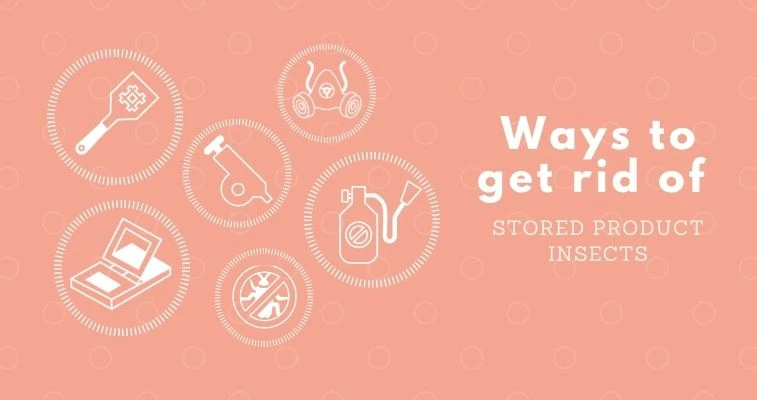
Getting rid of pests, regardless of the pest species types all require the same approach. They comprise of detection and spotting for early signs, controlling the pest presence through a pest control specialist and maintaining with housekeeping and sanitation efforts.
It is important to conduct detailed inspections of stored products and storage areas to identify an infestation as early as possible. Examine deliveries on arrival and make regular checks on food that has been in storage for a while — make sure suppliers and shipping or transport agents also have a regime of inspection and monitoring. The common signs of a stored product insect infestation are:
Pest detection and identifying their species types may be challenging especially among the untrained like us. Firstly, we might not know specifically where to look out for pest signs particularly in a large compound such as food manufacture or warehouse. Secondly, most pests are tiny and we can miss out detecting them especially in hidden spaces and corners. Thirdly, there are millions of pest species that we are not trained to identify. Wrong pest identification can result in detrimental outcomes by delivering the wrong pest treatment, causing infestation to escalate. In summary, the first step in SPI control is to detect proactively and ensure the right pest identification.
Pest control for a food sensitive environment is utmost important. The main line of defence in a food facility is to eliminate insects that get into the building without contaminating any food products.
Electric fly killers are an efficient way to attract and safely contain any flying insects. Rentokil Initial has a cutting-edge innovation; the Lumnia Fly Control has UV LED bulbs that are highly attractive to insects. They effectively captured and secured pests inside the unit with glueboards and contained within safely. One of the key feature benefits of the Lumnia technology is its energy savings function that helps businesses save on heavy operating costs especially in a large compound. It also has an adaptive mode that coordinates with the environment while maintaining optimal catch rate.
Besides the fly control unit, complementing solutions are also recommended to ensure optimal control. This includes misting or spraying at targeted corners and treating for other pests that are common in a food space. These include ants, flies, cockroaches, rats and mosquitoes. Pest treatment is not just guarding internally where food sources are, but guarding the external compound where pest entries can take place.
You may also like: What you need to know about indoor and outdoor pest control
While you have a robust and efficient stored product insect solution in place and the active lookout for pest signs, these are not sustainable unless there is active efforts on premise end to ensure diligent housekeeping regime, proofing elements and well-designed environment to prevent cross infestation.
Start to take more notice in the surrounding compound especially where there are opportunities for pests to enter. With their minute body size, they are capable of traveling from place to place and enter from any possible gaps without your notice. Here are some proofing considerations to undertake:
The design of the structure and property can affect pest presence and with some adjustments or change in design, it strengthens the control of pest presence and their activities. Here are some design adjustments to enhance the control effort.
Call Rentokil Singapore at (65) 6347 8138 for a pest control solution today.