(65) 6347 8138 Call us for a free quote Contact us

What You Need to Know About Spiders

Spiders can often be a big issue for people – especially for those who suffer from arachnophobia. Although there are positive things about these eight-legged creatures, they have become a pest in most homes due to their bites, which can pose health risks in some cases, based on the species and people’s irrational fear of them. Rentokil shares different spider species, how to deal with spiders with professional pest control.

Spiders are actually arachnids. They have eight legs – not six like all insects – and they lack antennae. They belong to the arthropod family of animals. Like all arthropods, they are characterized as exoskeleton, segmented body and jointed appendages. Spiders have chelicerae, which is a fancy scientific word to describe their mouthparts. Their mouthparts contain fangs that can inject venom!
What You Need To Know About Spiders Species

Spider Species

Spiders come in many different shapes and sizes. It is estimated that there around 43,000 different species of spiders found across the globe. It is important to note that not all spiders are pests. Some of them live in tropical climates, deep in the forest far away from people, while others can be very beneficial to your garden, being predators to a handful of garden pests. Of the many different species of spiders, there are five regarded as the world most deadly due to the strength of the venom in their bite.

Black Widow Spider

It is probably the most well known venomous spider. Identified by its black colour and contrast red, triangular and hourglass-shaped body markings, this spider’s bite can pack a punch. Although they generally prefer to hide from people in their webs, they will bite if their webs are disturbed.

Brown Widow Spider

A cousin of the black widow, the brown widow spider is another spider with a venomous bite. Compared to the black widow, brown widows are usually lighter in colour, ranging from tan to dark brown, although they can sometimes be black. Brown widows share the same hourglass-shaped marking; the markings on a brown widow are usually orange/yellow.

Red Widow Spider

Like other widow spiders, the red widow female’s venom is a neurotoxin that can be harmful to people. As you have probably guessed, the red widow spider (Latrodectus bishopi) is a reddish color. It has a black abdomen and, unlike its cousins, it does not feature a complete hourglass marking, but rather a series of small red markings.

Red Back Spider

The red back spider (Latrodectus hasselti) is another member of the widow (Latrodectus) family of spiders. The red back spider is native to Australia. It is black in color and can be identified by the prominent red stripe/hourglass-shaped mark on its back (although this can sometimes be absent or broken into spots in front with visible white lines).

Funnel Web Spider

Funnel-web spiders refer to the Dipluridae family of spiders who get their name from the funnel-shaped webs they build. These arachnids are usually large in size and a brownish/black color (this can vary depending on the species). The bites of some species can cause serious health complications.
Spiders Facts

Interesting facts of spiders that you may not know

  • Spiders are everywhere: This might freak you out, but some research suggests that you are never more than ten feet away from a spider.
  • There are many spiders: There are as many as 30,000 types of spiders currently known.
  • Not all spider bites are deadly: Only a few species cause nasty bites due to their venom that causes risky health complications. Majority of spiders will not bite humans and even if they do, they are not strong enough to inflict any damage.
  • Female spiders have large appetites: In some cases, some female spider species will eat the male spider before, during or after copulation.
  • Spiders love to dance: The peacock spider, Maratus valans actually dances as part of their mating ritual and they have bright colours on their abdomen that make it a great spectacle to watch.
  • Spider silk is strong: Spider silk is actually strong. It looks weak and brittle because of its thin depth. However, the spider web is in fact five times stronger than a strand of steel with its same thickness.
  • Spiders have blue blood: There is a science behind this fact. For humans, oxygen is bound to a molecule that contains iron that gives our blood the red colour. In spiders, the molecule that oxygen is bound to contain copper, hence making their blood colour blue.
  • Spider silk is liquid: While we know spider silk is in the form of webs, but they are actually liquid. When silk comes into contact with the air, it hardens and thus allows them to build webs.
  • Spiders have strange muscles: Strangely, their muscles can only pull their legs inwards and are unable to extend them again. Hence, spiders will pump a watery liquid into their legs to help push them out again.

You may also like: The top six common pests phobias

What You Need To Know About Spiders Bites

What we need to know about spider bites?

The potential for a spider to give a nasty bite can be a big concern for both homeowners and businesses. However, it is important to note that spiders rarely bite humans and only do so if they feel threatened or provoked. In some cases, the spider’s fangs are not strong enough to pierce your skin.

Dealing with spider bites

It can be difficult to diagnose spider bites as they are often mistaken for skin boils or infections and most bites often go unnoticed. To add to this, the appearance of a spider bite can differ depending on the species of spider involved. Some of the symptoms include:

  • Range from a mild reaction such as inflammation of the skin
  • Minor swelling and itching
  • Severe reaction causing lots of pain, gangrene and even necrotic wounds
  • Resembles two tiny holes or bumps or appear as a single red bump
  • Dry and painful bites for some species
  • Treatment for spider bites depends on the species. For the most part, a spider bite requires little to no medical treatment. However, if a spider such as a black widow or a funnel-web spider bites you, we strongly advise you to seek urgent medical attention and treatment. Generally, is to leave them alone, however do wash the wound to ensure there is no infection. You may bandage the wound however keeping it clean is key. In the event of an itching wound, you can apply anti-itch lotions that can be purchased at pharmacies. If you experience an allergic reaction such as fever, vomiting or other medical symptoms, do seek medical attention immediately.
    Debugged Blog What You Need To Know About Spiders Reasons For Spider Infestation

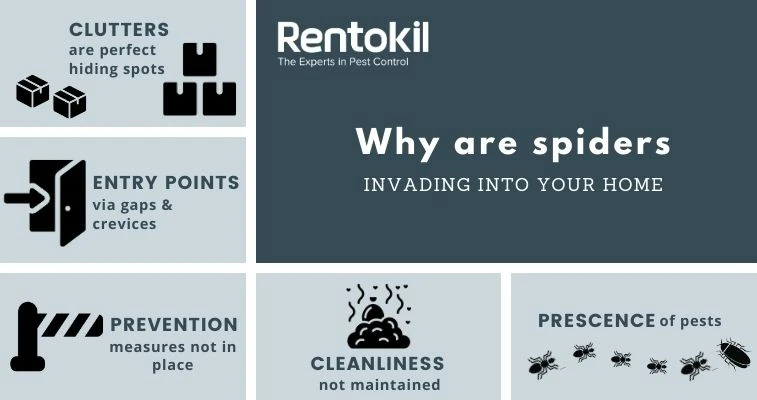
    Why are spiders coming into your home?

    Most of the spiders you see around your house have probably been living there for a while. There are many reasons your home may be inviting spiders inside. Here are some causes of a spider infestation:

    • Clutter: Spiders are expert hiders and more mess and objects left out means more hiding spots in which they can make their home and start a family. Stacks of books and magazines, stuffed closets, and underneath messy beds are all perfect hiding spots for spiders.
    • Easy ways to gain entry: There is a good chance that the spiders are getting inside via gaps in your building’s structure. Even a small crack in a window or door is enough for a tiny spider seeking shelter to crawl.
    • Uncleanliness: Spaces that are dusty and dirty welcome bugs of all kinds and where there are bugs, there are hungry spiders. Procrastinating housekeeping is one of the main causes of pest infestation.
    • No preventative measures: Failing to maintain the perimeter of your home by cutting grass and trimming shrubs will increase the risk of spiders coming inside.
    • Presence of pest infestation: Spiders eat other insects such as cockroaches, flies, crickets, thus pest problem provide food source for spiders
    • Lack of pest control: Regular visits from a pest control specialist help to identify the spots in your home vulnerable to spiders. Pest control specialists can also put preventative measures in place to stop spiders from returning to your home.

    Spider infestation signs

    Generally, spiders like dark and secluded areas including the garden. They seek a food source in your home especially if there is an existing pest infestation. Here are some infestation signs to take notice:
    • Spider webs: Size and shape of spider webs vary. Some are orb-shaped while some are funnel-shaped. For some species, they create geometric webs that trap insects in hidden areas.
    • Burrows: Some spiders live in burrows rather than webs, while some are free-roaming and others seek refuge in cracks and crevices.
    • Moist environments: Spiders like wet and moist environments especially at the basement, walls, sheds and any other damp locations.
    • Hiding nests: Look out places including the attics, junction of wall and ceiling, closets and storage boxes
    • Spider eggs: Eggs are laid into a silken sac, on average 100 eggs in each sac
    What You Need To Know About Spiders Preventive Tips

    Spider preventive tips

    While there may not need to engage in pest control services, there are ways on how to get rid of spiders. Here are some useful tips you can adopt for your home:

    • Vacuum regularly: Housekeeping is key and in particular at sheltered hot spots such as beneath the worktops, backs of cupboards, appliances and furniture
    • Remove any noticeable webs
    • Fix the cracks and crevices: Fill those gaps around the walls, around pipework and under doors to deter spider entry
    • Eliminate sheltering sites: This includes piles, garden bags, compost piles and clutters around your home
    • Avoid placing boxes on the floor and by the wall, taped and close those box openings
    • Apply lighting: Deter pests with lighting as it is less attractive to some pests such as flies which spiders feed on
    • Ventilate the home: Make sure crawlspaces and attics are well ventilated to decrease moisture level. Moisture and water are one of the main causes of pest infestation.
    • Detect and inspect: Examine objects and items that are carried from outside for presence of latched-on spiders

    Professional spider control services

    As your local spider control specialist, Rentokil Initial is trained and licensed on pest eradication includes complex, common and home annoying pests. Reputable and credible pest control company will perform a full site risk assessment and survey of your premise, identify key areas, recommend pest control solutions and advice for your pest removal needs. In addition, monitoring and ongoing inspection is also carried out to ensure your pest infestation is under control. Here is what to expect during and after the service:

    • Advice on recommended treatments and price of the pest control to engage
    • Pre-treatment checklist to prepare the premise for service
    • After-treatment checklist for health and safety purpose
    • Housekeeping and proofing tips and recommendations
    • Monitoring and reporting of the service and pest condition

    For more information on spider control, spider prevention tips and pest control solutions, contact Rentokil Singapore at (65) 6347 8138.

    Pest control services

    • Don't just imagine your business with no pests...experience pest-free with Rentokil.
    Contact us

    Related posts