myRentokil
myRentokil login© 2026 Rentokil Initial plc and subject to the conditions in the Legal statement
Rats in Singapore annoy businesses, especially the food establishment where food safety, brand image and regulatory compliances are top priority. However, it will stress homeowners or the public with their hazardous acts including food contamination, rat bites and gnawing habits. In this article, Rentokil shares the top ten rat blog trending articles useful rat prevention tips you can adopt to safeguard your family and customers.
Why are rodents smart enough to escape from our lure and trap and make pest management challenging? This is because they possess some positive attributes that keep them safe from pest control solutions.
Firstly, rats are very agile, flexible, and able to squeeze themselves through impossible spaces and gaps as small as 1cm. This also explains why they can balance well on beams and hide at tight corners along the ceiling. Secondly, they are capable of producing good volumes of offspring to build substantial populations of rats. In fact, on average they reproduce up to eight times in a year, which contributes as much as 2000 offspring per rat couple. Thirdly, they do not fall into your trap easily, especially unfamiliar environments or items they have not seen in the past. Hence, you may notice that placing multiple bait units may not necessarily trap those running rats. Fourthly, they are dependent on food sources that can be found easily in our premise or homes. They feed on nuts, cereals, grains, wheats and even any scraps or leftovers from the bins.
Finally, not only can they hide well in hard to spot spaces including false ceilings, burrows and corners, they are nocturnal and only surface at night for food.
Some of the night driven pests that emerge during the time we sleep are bed bugs, cockroaches and rats as well. Because of their nocturnal nature, pest detection is not easy, and if we do see them in the daytime, it could mean a serious infestation where there is an overpopulation of rats of food source competition. The only opportunity to spot for rat activities is the pest evidence they leave behind, including their droppings, urine stains and stench, smear marks, burrows, gnaw bites and scratching sounds. Hence, having proper pest inspection and monitoring is necessary to monitor their presence accurately and adequately. There are inspection technologies including rodent and pole cameras for challenging accessibilities and digitalised rodent control to sense and detect rat movements through a command center.
There are natural pest remedies and attempts to keep pests away by using scent masking as a repel method. Some of the popular choices include the use of garlic, pepper, cinnamon, vinegar and even essential oil such as lavender, eucalyptus, citronella and peppermint oil. However, do scent variation matters and more importantly, are they effective in getting rid of rats? Regardless of the options, the pungent and strong scent mask the smell navigation of pests basically, confusing them for a short while before they regain their chemical signals back to track their food source. Hence, it works by relocating rats to another hotspot, and worse of all, spread its presence around the premise. Pest prevention requires proper rodent control, coupled with sound proofing and diligent sanitation standards in the environment.
Read also: What are the various pest myths we used to deter pests
Besides bed bugs and termites that are notoriously known as the challenging pests to eradicate, rats are as tricky as well. Firstly, they have their intelligent instincts to avoid being lured, detected and trapped from our pest eradication efforts. Secondly, they tend to avoid traps and baits or objects and baiting units that do not look familiar with them. Thirdly, unlike pests such as cockroaches and ants that are a lot visible to our eyes, rats tend to be out of sight, and thus keeping them safe from our rat control measures. Fourthly, the type of baits and trapping units matters. Bait alternation is critical and moving towards digitalisation in pest control heightens detection and control efficacy.
Finally, there must be consistent and ongoing monitoring for any rat activities to ensure we do not lose sight of rats’ presence. Above all, we have to do our part in maintaining good standards in cleanliness and sanitation to eliminate shelter, water and food sources for rats to feed.
Rats are carriers of various bacteria and viruses as they move around poorly sanitised environments, for example, false ceilings, drains and sewers, basements and waste areas. This is especially so when they leave their pathogens, droppings and urine on food sensitive surfaces including food preparation, ingredients, utensils and cutleries. Some of the diseases rat caused include:
You may also like: Find out the various pest bites you need to know
We are well aware that rats are good in hiding and are secretive enough to escape from our detection. However, there are some telltale signs you can look out to address the pest infestation before it is too late.
How much do we know about rats and their habits besides the fact that they can cause health implications and hazardous outcomes such as short circuits and fire?
Firstly, they have excellent memories in direction and navigation and are efficient in escaping from dangerous routes while traveling safely to obtain food sources. Hence, some individuals attempt to break the chemical signature by using scents to break the sense of smell. Secondly, they have good balancing skills with their tails along thin bars and beams along false ceilings and their tails have a lot more functions including temperature regulation and defense mechanism when predators challenge them. Thirdly, they can stay under water well, and are natural born swimmers and hence, hanging around wet conditions including bathroom, drains and sewers are not a challenge for rats. Fourthly, they have a flair for climbing, and thus they tend to hide high up where reach and visibility is impossible among individuals including ceiling, attics and roof.
In summary, they have a series of strengths and capabilities that are able to escape from pest control measures and require professional pest control specialist to put proper control in place.
Read also: Useful FAQ on rats including what attracts rats to a premise
Rat infestation should be addressed as soon as possible because of the damages and consequences they can cause to our health and safety. Here are some reasons how rats’ presence can be a threat to us:
No, rats and mice do not mean the same thing though they fall under the rodent family. There are differences in both and in fact, there are specific mice control in Singapore that addresses their hideout, and size of their body and nature. Some of the difference between rats and mice besides the size wise includes their physical outlook where rats’ snouts are blunt or pointed and would vary in terms of their species type. A mouse on the other hand has a pointed snout, but with large ears and lighter in body weight, typically range from 12 to 45 grams compared to rats weighing 200 to 300 grams. Next is their habitat where they have different preferences on where to hide and nest, preferred food source and modes of invasion.
Finally, is their reproduction difference where mice are efficient in reproducing as many as sixty pups in a year compared to rats’ reproducing a range of eight to twelve pups a year.
Dealing with rats requires sound and good knowledge in rat species in Singapore, including their diet choice, hideouts, what attracts them and ways to control rat infestation. In this article of “The Complete Guide for Rats Control in Singapore”, Rentokil Initial shares essential information relating:

There are many ways to get rid of your rats’ problem. They range from DIY, using natural remedies or engaging a pest control company to manage the detection, treatment, monitoring and recommendations for you. Some of the DIY options include purchasing off-the-shelf baits and traps in an attempt to catch those rats or using the repelling options by chasing them away with unpleasant smell. However, these are either short-term solutions or merely deterring them away. They do not fix the root source of the problem, which is to remove their nesting grounds. In addition, when applied wrongly or inadequately, it not only worsens the condition or harms your own health and safety, especially when dealing with baits and toxics.
Professional pest control services have a structured and certified way of carrying out a rat control programme. This includes using detection technology such as rod cam to detect rats’ activities at high levels or at night on a recording. Next, is to study the environment, key risk areas, nature of the premise to determine specific locations to treat. Locations are typically spots with high rat activities or areas they passed by. There are various control methods including setting up a cage with a bait, placing of glue board in order to trap them or utilising sensing technology to detect their movements through a connected platform while triggering control on demand. This way, we do not miss detecting their presence while heightening the control level with targeted placement of the tamper resistance baiting stations.
There are many units to cater for different trapping purposes and capacities. Some are designed for mice control; while some meant for heavy infestation where the unit can trap over twenty rodents at one go , while the others are for rats and placement at tight spaces such as the Rentokil Connected Rat Riddance. The specialist chooses baits and rotate them to ensure efficient attraction and luring to the unit successfully. Depending on the design and nature of the environment, level of infestation, condition and integrity of the property and risk assessments, the number and type of baiting control is customised, with varied frequency and combination of integrated rodent control programme.
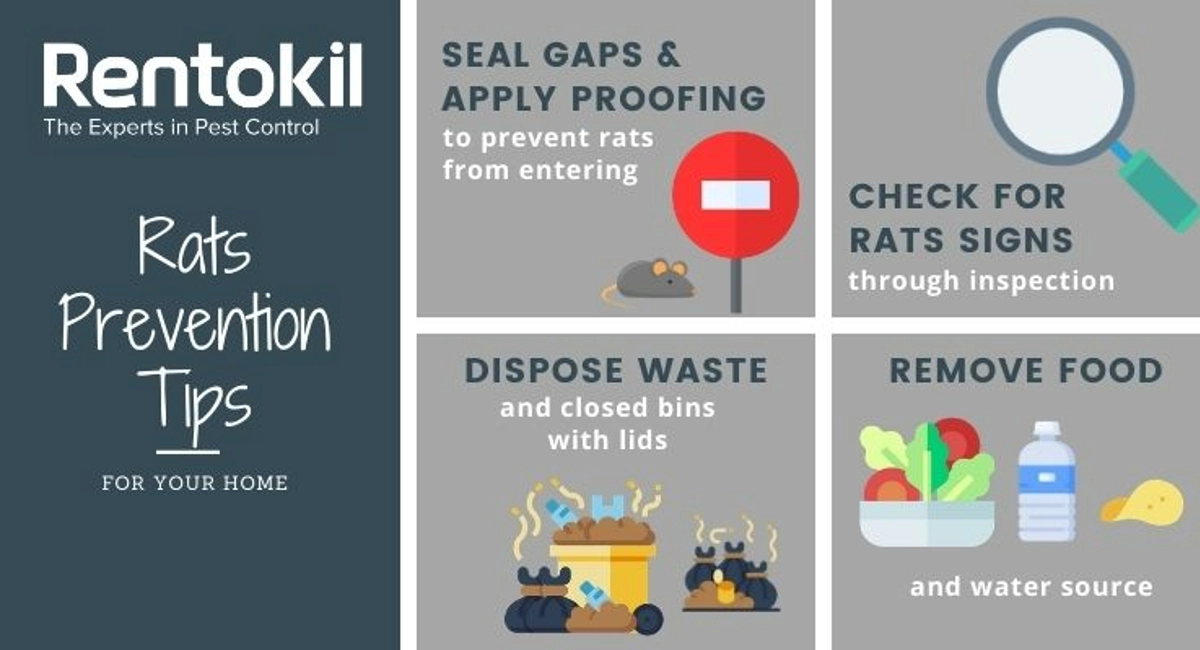
Firstly, rats can transmit harmful diseases and contaminate food with their bacteria they carry with them. Secondly, they can cause risky property and safety outcomes such as damaged furniture, structures and hazardous fire. Thirdly, rat bites can be severe especially by infected species and require prompt medical attention. Fourthly, for food driven and high dependency businesses, rat infestation can implicate operations, financial consequences and business sustainability. Above all, is the ruined reputation and negative customer impression of the company.
Read also: What are the complexities in running a food processing business
A rat control programme consists of the following:
Find out on the various rat control solutions offered by Rentokil Initial
There are many rat species around however the three common ones include:
Rats can be found almost anywhere due to their capable swimming and climbing skills, not forgetting their ability to balance and hide well. Here are some hot spots you should check for rat infestation signs.
Rodent control can be ineffective due to various reasons. Firstly, it may be a result of a wrong and insufficient placement of baiting units, hence unable to lure and trap the rats. Secondly, the line of defense against rats’ entry may be inadequate thus allowing cross infestation to occur. Thirdly, integrity and condition of the premise matters, while any possible holes and gaps are opportunities for rats to enter. Fourthly, proper housekeeping and sanitation activities with usage habits of the employees can make a difference in controlling rats’ problem. Finally, there could be an underlining nesting ground that goes undetected and allows rats to breed in the premises.
The cost of a rat pest control is dependent on a few factors:
You may also like: How much does it cost for a pest control service in Singapore
Call Rentokil Singapore at (65) 6347 8138 for pest control services today.