myRentokil
Manage your business
The summer season brings with it longer days, warmer weather, and unfortunately, a familiar buzzing nuisance: mosquitoes. While often considered an annoying part of the warmer months, these insects pose a greater threat than a simple itchy bite.
Mosquitoes are vectors for some of the world's most serious diseases, including West Nile virus and dengue. As climate change and global travel continue to alter ecosystems, the risk of mosquito-borne illnesses is increasing, even in regions where they were once rare.
So, how can we effectively combat this growing health concern?
We sat down with Ruben Bueno Mari, a leading expert in vector control and Technical Director at Rentokil Initial, to discuss the critical importance of Integrated Mosquito Management (IMM). Reuben is one of our Technical Directors for Vector Control in Europe and a past President of the European Mosquito Control Association. He has a PhD degree in Medical Entomology from the University of Valencia and numerous journal publications.
His area of expertise is designing and implementing large-scale vector control programs, including mosquitoes, blackflies, sandflies, and ticks, amongst others. He has been acting as an expert consultant for the European Union, supervising and advising in terms of national mosquito control programs in several countries. Now he’s deeply involved in developing comprehensive vector control protocols to reduce the impact of mosquito-borne diseases like dengue or West Nile virus in Europe.
Below, Ruben explains why understanding the mosquito lifecycle is key, how surveillance and community involvement are crucial, and what makes IMM the most effective strategy for protecting public health from these dangerous pests.
Yes, they are, and this isn’t something new. From playing a key role in influencing the known development of ancient Egyptian, Greek and Roman civilizations, to having a clear impact on recent episodes like World War II and many other civil wars that occurred in the last decades and centuries, mosquitoes and mosquito-borne diseases have dictated the outcome of significant events throughout human history.
The difference now is that global changes are benefitting mosquito-borne diseases almost worldwide. Climate change, globalisation, insecticide resistance, massive and unplanned urbanisation, and ecosystem modifications are provoking the spread of mosquitoes and associated diseases through all five continents.
In the European context, West Nile virus is considered endemic nowadays despite the African origin of the disease. This virus is mostly transmitted by the common house mosquito Culex pipiens, which is extending its activity to almost all over the year in Southern and Central Europe thanks to climate change.
Dengue is also a serious problem for Europe today. The Asian tiger mosquito Aedes albopictus caused more than 100 autochthonous cases of dengue in 2023 in the Mediterranean countries of Italy, France and Spain. So, yes, mosquitoes are a real and growing risk for Public Health in Europe.
IMM uses a combination of methods to prevent and control both nuisance mosquitoes and mosquitoes that spread disease. Mosquito control plans include controlling insect populations before people start suffering from mosquito bites or getting sick due to mosquito activity. Properly implemented IMM can be highly effective in reducing mosquito-borne diseases, such as malaria, dengue fever, and Zika virus.
IMM uses methods to control mosquitoes based on a deep understanding of both the biology of specific mosquito species and their life cycle, combined with the way specific species spread viruses. The methods used, when followed correctly, are safe and have been scientifically proven to reduce mosquito populations.
The basic components of IMM include surveillance, source reduction, control of all mosquito life stages, insecticide resistance testing, public education, community involvement, and evaluation of actions taken.
The lifecycle of a mosquito involves four stages: egg, larva, pupa, and adult. By understanding each of these different stages, we can identify vulnerable points in the lifecycle for intervention and then implement targeted strategies for controlling and preventing the spread of mosquitoes at all stages - from egg through to biting adult.
Stage 1 - eggs: Female mosquitoes lay their eggs on or near standing water. The eggs can be laid individually or in clusters, depending on the species. They hatch when they come into contact with water, typically within a few days to a week. By understanding when and where mosquito larvae develop, we can implement strategies such as larvicides to interrupt their growth at the aquatic stage.
Stage 2 - larvae: Once the eggs hatch, they enter the larval stage. Mosquito larvae, often called wrigglers, live in the water and feed on microorganisms and organic matter. They undergo several moults, growing larger with each stage.
Stage 3 - pupae: After the larval stage, mosquitoes enter the pupal stage. Pupae, also known as tumblers, are relatively inactive and don't feed. During this stage, they transform into adult mosquitoes. Pupae typically remain near the water's surface to breathe through specialized respiratory tubes.
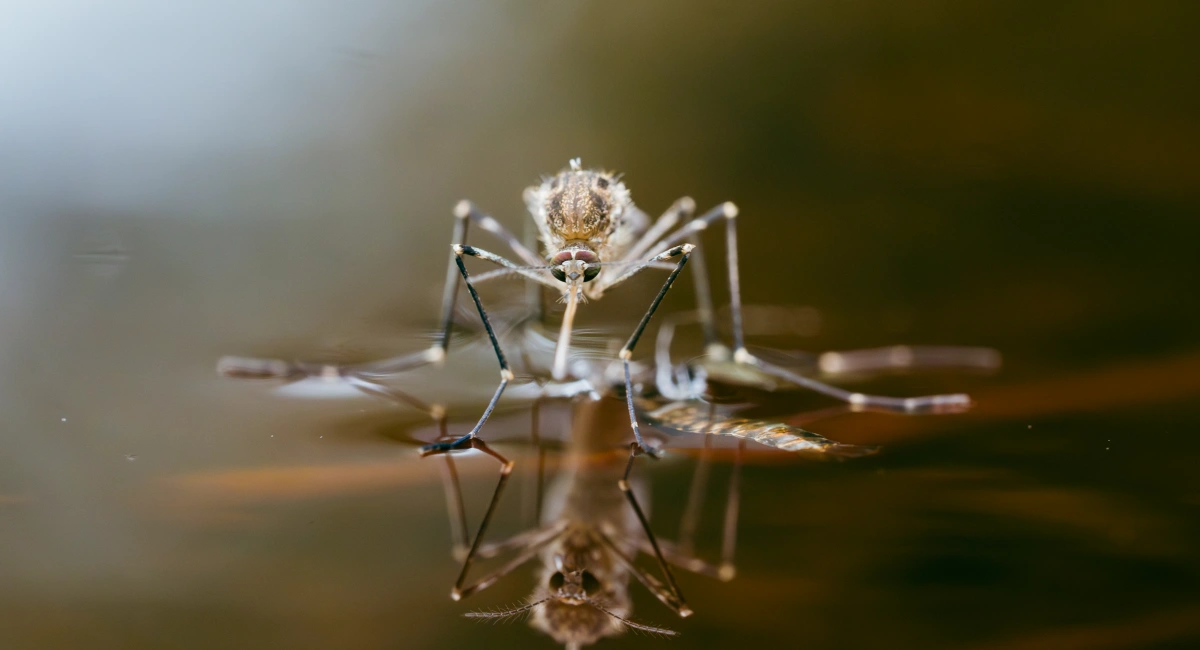
Stage 4 - adults: After the pupal stage, adult mosquitoes emerge from the water. The newly emerged adults rest on the water's surface briefly to dry and harden their exoskeletons before flying away. Adult mosquitoes primarily feed on nectar from plants, but female mosquitoes require a blood meal to develop and lay eggs. They seek out hosts, including humans and animals, for blood meals.
This knowledge aids in the development of proactive rather than reactive strategies. By anticipating peak mosquito activity based on their lifecycle, we can implement preventive measures before populations surge, reducing the risk of disease transmission and enhancing overall effectiveness.
This is why the site inspection is one of the most important elements of integrated mosquito management. The inspection aims to identify every possible mosquito breeding site and adult resting place.
With over 25 years of experience in mosquito and vector control, Rentokil is a leader in combating these pests. Learn more about our commercial mosquito management solutions to help protect both your business and home.
Tailored, reliable pest management for homes and businesses, ensuring pest-free spaces for work, life and play