myRentokil
Manage your business
Have you ever wondered if a house fly could lay eggs on your food and what would happen if it did? We’ve all experienced flies buzzing around our food in warm weather and instinctively swatted them away because we think they are dirty. But what are the real risks from houseflies and their eggs?
This article explores the biology and behaviour of houseflies, their feeding preferences, if they would lay eggs on food, the real risks you should be worried about, and how you can prevent them.
Understanding the lifecycle of the house fly, Musca domestica, gives key insights into ways to control it both directly and indirectly. For example, knowing the types of sites they can breed in and how long each stage of the lifecycle takes, indicates where and how frequent action such as clearing waste and cleaning needs to be done.
As with most insects, houseflies have four stages in their lifecycle, the duration of which depends on environmental factors such as temperature and food supply:
Egg → larva (maggot) → pupa → adult
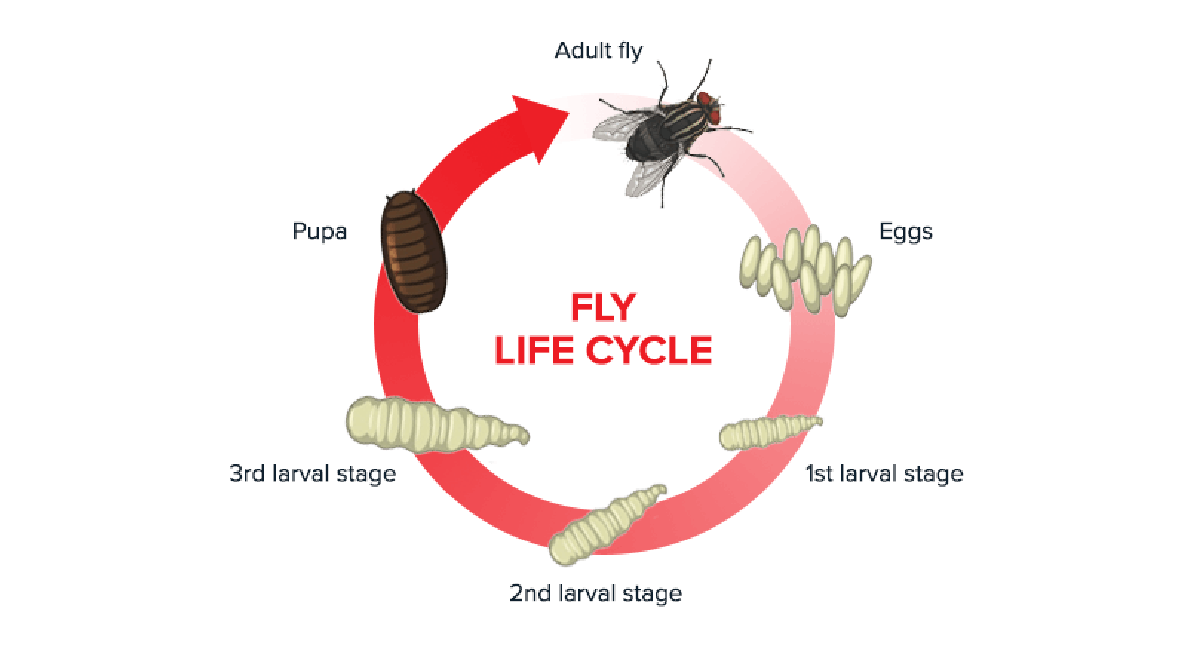
House fly eggs are white, about 1mm long, and shaped like grains of rice. They are laid in small groups, and often multiple groups from different flies are located together. Eggs are laid on or just under the surface of moist, decaying organic matter such as fresh animal manure, decaying vegetable matter or decaying kitchen waste. It is highly unlikely, therefore, that a fly will lay eggs on fresh food in your home or a restaurant. Eggs hatch into larvae in 8-20 hours, depending on the temperature.
Larvae are creamy white and cylindrical, tapering towards the head. The larvae, commonly known as maggots, feed on bacteria in decaying matter. They develop through three instar stages and grow to 7-12mm long. They cannot develop without bacteria, so female adult house flies need to seek out decaying matter to lay eggs on, not dry or fresh food.
Larvae can complete development in 4–13 days at over 30°C and 14–30 days at 12–17°C. The time taken to develop also depends on the nutritional value of the decaying matter.
Various studies have found different animal manures to be more or less productive (horse, swine, cattle or poultry) and rotting vegetable waste the least productive. Larvae can develop in low-nutrition environments, such as weak concentrations of dairy manure in sand, but it takes longer for them to consume adequate nutrition. When larvae are fully grown, they crawl to a dry, cool place nearby to pupate.
During pupation, the larva forms an outer case from its skin. It can be 4–8mm long, blunt at both ends and turns from creamy yellow to reddy brown and then black as it ages. It completes metamorphosis into an adult in 2–6 days at 32–37°C and 17–27 days at 14°C. The adult house fly breaks open the pupal case by repeatedly expanding a sac on its head till the case splits and it can emerge.
Adult house flies immediately seek food sources on emerging from the pupal case. Males and females have different food preferences. Male house flies prefer carbohydrate-rich food, while females require protein-rich food for ovary development and egg production, such as blood (from meat or dead animals) and mucus. Females also feed on carbohydrate-rich foods as they require energy to search for oviposition (egg-laying) sites, so visit a wider range of potential foods.
Female house flies carry more microorganisms than males, which is likely due to their feeding and oviposition behaviour, which exposes them to more rotting organic matter.
To produce eggs, an adult female house fly must mate, mature physically to produce eggs, which are then fertilised, and develop the eggs. Female flies generally mate only once, within 1–2 days of emerging and produce eggs in several clutches over their lifetime.
A study of the effect of temperature on house fly egg production in laboratory conditions found that higher temperature (32° compared to 25°C) resulted in faster time to egg production but a shorter lifetime and fewer total number of eggs.
| 25°C | 32°C | |
|---|---|---|
|
Time to start producing eggs |
6 days |
1.5 days |
|
No. eggs in first clutch |
75 | 72 |
|
Clutches per female |
6 | 6 |
|
Oviposition period |
17 days | 11 days |
|
Total No. eggs in lifetime |
440 | 350 |
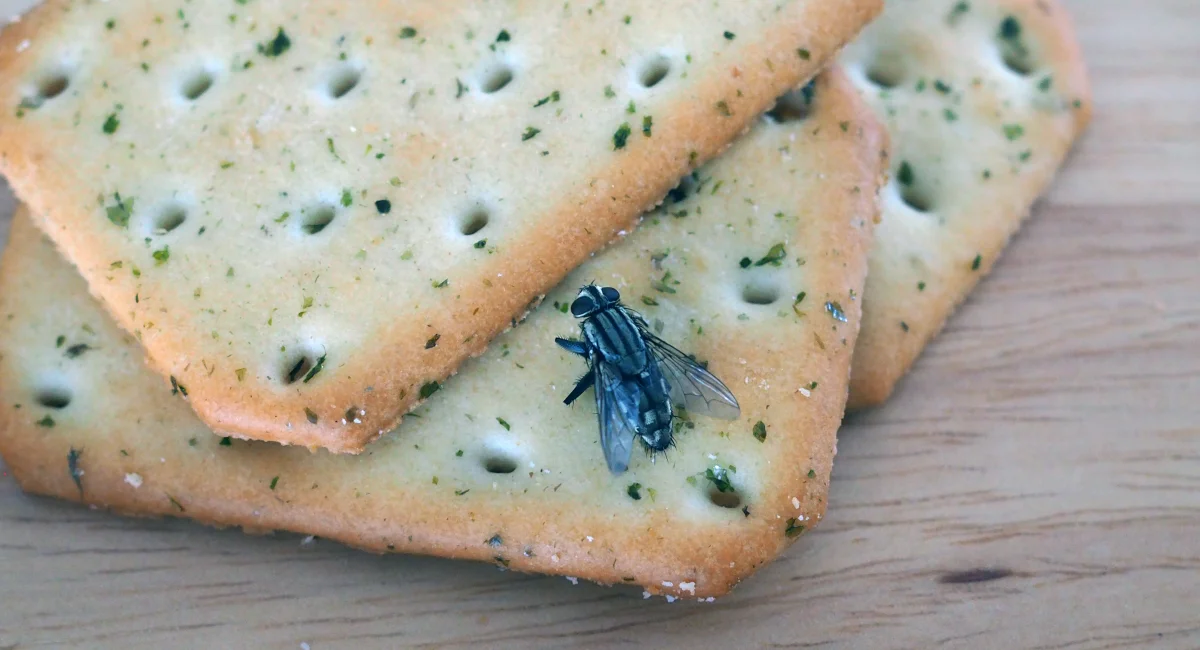
The risks from house flies are the microorganisms that they carry on and in their bodies from breeding and feeding in places with rotting organic matter, such as manure, faeces, dead animals and rotting food waste.
House fly feet and bodies transmit microorganisms onto food and surfaces they land on. Their mouth parts also carry microorganisms and house flies regurgitate gut contents onto solid food to liquefy it. They also defecate on food and surfaces that they land on.
As described earlier, flies need to lay eggs in decaying organic matter because the larvae feed on bacteria, so it is highly unlikely house flies will lay eggs on fresh food. Also, the eggs would not be as great a risk for contamination as the adult flies as they wouldn’t have come into contact with rotting matter.
As mentioned, the time for a house fly to complete its life cycle varies greatly depending on temperature and food availability. This also means that the warmer the temperature, the more frequently you need to dispose of waste that they could feed on and breed in.
.2025-05-09-09-00-16.webp)
Maintain food hygiene practices to prevent house flies from accessing food, including covering food, cleaning food preparation areas, and proper food storage. Remove or isolate any materials on which flies can lay eggs, such as household food waste, rotting grass or other vegetation.
Put food waste for disposal in sealed plastic bags and in dumpsters with tight-fitting lids. Make sure waste is collected regularly to prevent any eggs present from being able to complete their lifecycle and develop into adults. Flies can breed in compost, so cover any food scraps or grass cuttings with other matter such as leaves or soil and use a tight-fitting lid.
Use screens on windows and doors to prevent flies from entering your home and use fly traps to capture flies. To prevent contamination, insecticides should be used with caution, only according to the manufacturer’s instructions and not near food.
Flies laying eggs on your food is highly unlikely. The main risk is contamination of food with microorganisms that flies carry from rotting matter such as manure and food waste. The key to controlling flies is preventing them from accessing your food and breaking their lifecycle where possible by preventing them from having anywhere to breed.
Technology and data-driven digital pest monitoring for effective, smart pest management solutions